


 General Assembly
 Security Council
1
Dispatch → Factbook → Overview
by  The State of Snefaldia.
.
67 reads.
The State of Snefaldia.
.
67 reads.
General Overview
Fèndëh Sûł Hoptŏgën
Taksan Ḫattišani
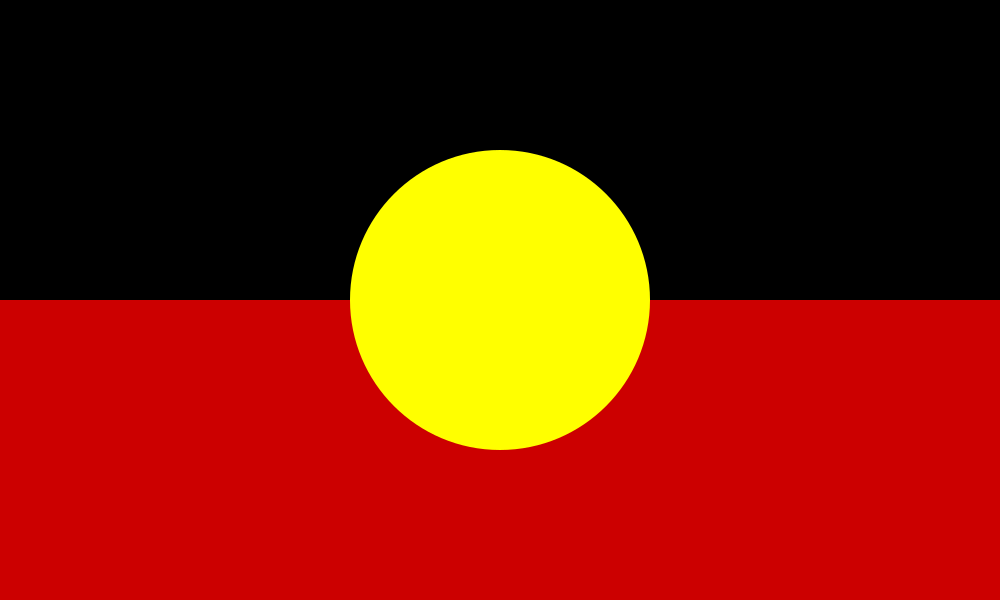
Flag
Map


Within the Western Atlantic
Capital: Sargedaín
Largest City: Taxilha
Official Language: Standard Snefaldian (Našili)
National Languages: Standard Snefaldian, Sringi
Demonym:
English: Snefaldian
Standard Snefaldian: Ḫuurŷ Hoptŏgën "Snefaldian Person"
Hoptŏgën Chuuŗ, "the People of Snefaldia"
Standard Luwish: Hašam Ḫattišani
Government
- High King: Zannanza (House of Parshtatar-Luwas)
- Lord Chancellor: Zylván Hossä
- Minister of State: Ilionás Sondrásái
- Minister of Foreign Affairs: Mighîl Atatarï
- Chief Justice: vacant
Legislature: - National Snefaldian Bėl
Establishment:
- Under Aatem Nal: 1455 CE
- Segovan: February 4th, 1701 CE
- Republic of Snefaldia: April 23rd, 1895 CE
- Tuhran Bel: October 25th, 1963 CE
- States-Federation: April 23rd, 2008 CE
- Supreme Council (Military rule): October 31st, 2013 CE
- Democratic Restoration: November 9th, 2020 CE
- First Elections: March 2021 CE
Population: 389,000,000
Population density: people per km²
Land Area: 2,724,900 km²
Water %: 5
Elevation
Highest Point: Mount Tahhsin, 7,567m
Lowest Point: Yto Marsh, -4.6m
PDAS Development: B- (2011)
Currency: me-wak
Calling code: +57
Internet TLD: .sne
ISO Code: SNEF
Snefaldia, officially the States-Federation of Snefaldia, (Standard Snefaldian: Hoptŏgën or Fèndëh Sûł Hoptŏgën; Standard Luwish: Taksan Ḫattišani), is a large country almost entirely surrounded by mountains and bisected by the Saard river, which runs south to the Bay of Fuschal. The word "Snefaldia" is a corruption of the Old Frisian snē and falle, a term used by Knootian travellers in the 13th century.
The States-Federation is a member of the Western Atlantic and maintains historic connections with Antarctic Oasis, where it formerly served as Regional Delegate. Snefaldia has an area of 2,724,900 km², 5% of which is water.
Arable land is 38.44% of the country. The average life expectancy is 74 for men, 77 for women, with a low infant mortality rate, high literacy rate, and a ranking of B- in the PDAS. The population is concentrated in large regional cities and distributed throughout the countryside, with variations according to region, climate, and landscape.
The largest city in Snefaldia is the port city of Taxilha, which surpassed the capital Sargedaín in population density per km² in January 2009.
Surrounded on four sides by mountain ranges, elevation ranges from the Velnar Mountains in the north (with the highest point at Mt. Tahhsin, 7,567m) to the Memdër Delta of Fuschal Bay in the south (lowest point: Yto Marsh, -4.6m). Snefaldia borders  Uncle Noel to the west,
  Daytanistan and
  Sabaristan in the north, and
  Kartlis in the northeast.
  Zamimbia is to the south. The four principal mountain ranges are the Seril Mountains in the east, the Zogar Range to the west, the Hightops in the south, and the Velnar Mountains to the north. The central country is dotted with lakes and valleys, and the Saard river bisects the country, running from the northeast Velnars down through the southeast Serils before emptying into the Bay of Fuschal.
The Dayan Basin spreads across the central plain and is the breadbasket of the country. The Dayan floodplain forms the economic and political heart of Snefaldia. To the north are the Sring Issan highlands, defined by old-growth deciduous forests, sharp hills and low valleys, and small, numerous lakes. South of the Saard and Dayan is the subtropical Neer Dal (Dayan for "Great Forest"), home to marshes, expansive forests, and hundreds of small rivers.
To the west, in the foothills of the Zogar Range, is Allasha, a region defined by deep gorges and a hot, arid climate with cold winters, its population concentrated in river valley cities along ancient trade routes. The mouth of the Saard river forms the fertile, shallow Memdër delta; the rocky and steep terrain makes much of the surrounding area uninhabitable, but the rich alluvial soil has historically supported dense urban settlement. The high-altitude Shahd Plateau is cut by the Saard and rises from the Dayan plain to the sea and the port city of Taxilha.
Snefaldia has a mixture of subtropical, temperate, and Alpine climates. The mountains are high and rocky, descending in altitude through hillish terrain before flattening into the central plain; this change in elevation is reflected in the varied local climates. Many people live in the traditional Snefaldian village. Conservation and the environment are taken very seriously, with the government Ministry of the Environment & Conservation maintaining a list of protected natural sites. There are stringent penalties for pollution.
Most major cities and population centres of Snefaldia are often hundreds to thousands of years old. After the establishment of the Republic of Snefaldia in 1895, the complex system of regional counties and provinces was reformed and centralised; the 1965 Uniform Law established the modern system of 9 regional circuits and 1,200 administrative counties. Until 2014, several cities were classified as "Federal Metropoli" under the Basic Law, with special administrative status. These cities, now reclassified, remain important population and commercial centres:
Sargedaín, national capital and administrative centre of Dayan Region; largest metropolitan area in the country; seat of the Lord Chancellor and the Snefaldian government
Serasarda, seat of the faith of Aatem Nal and the Grand Library; religious and educational centre of the nation, located north of the capital in Sring Issa Region
Taxilha, largest city by population density and the nation's principal seaport, at the mouth of the Saard and the entrance to the Bay of Fuschal
Mavátêisnáya, administrative centre of Neer Dal Region; ancient seat of Neeri civilisation; home to the University of Great Teisnaya
Korsahad, administrative centre of Allasha Region; principal centre for stone and mineral production
Luwatarna, administrative centre of Karduniyaš Region; largest source of finished goods for export; home to Luwatarna University
Isaardlang, administrative centre of Sring Issa Region; ancient cultural and literary centre of Luwite civilisation
The capital of Snefaldia, Sargedaín, straddles the Saard river, the largest and most important river in the nation. Serasarda, the religious and educational centre of the nation, is located north of the capital in the region of Sring Issa. The second largest city is Taxilha, also the largest and most important seaport. Sitting at the mouth of the Saard and the entrance to the sea, Taxilha receives all the sea trade that comes into the country. Luwatarna in Karduniyaš is the largest source of finished goods for export, and has the highest percentage of skilled workers after Sargedaín. Korsahad, the capital of the Allashan region, competes with Mavátêisnáya in Neer Dal for production of raw materials — in Allasha the top being stone and minerals, and in Neer Dal being lumber and precious stones.
Due to its unique geography, Snefaldia has been largely isolated from outside exposure. Most foreign influence arrived through the mountain passes, and each region received a great deal of cultural influence from the peoples that made the trek over their respective mountain ranges.
The official language is Standard Snefaldian, based on Našili, the Central Dayan Luwite prestige dialect, formally adopted as the national language in 1990. Most Snefaldians also speak regional languages such as Sringi, Fehrdani, Kuwandi (all Luwite tongues), Beladanya Neeri, Sendaren Neeri, Kaššu, or Taxilhani, among other dialects. In 2016 the government issued new guidelines to develop a standard national language that avoided regional biases.
The Standard Snefaldian orthographic system — with its pharyngeal Ḫ, retroflex ŗ, and breve vowels — derives substantially from the Standard Luwish nationalist language project of the 1860s–1890s, whose vocabulary and orthographic conventions were absorbed into the Republican codification of 1895. Standard Luwish (Hašam Ḫattišani) itself continues as a pan-Luwite classical register used in formal legal, religious, and diplomatic contexts.
From 1395 until 1895, the language of diplomacy was Tausite, a sociolect particular to northern Dayan and southern Sring Issa that developed among the aristocratic and scholarly classes during the Dayaniram period. Tausite is now mainly a religious and clerical language, used in Aatem Nal administrative and liturgical contexts, but is still spoken in some areas of Sring Issa, especially by older residents in Serasarda and Isaardlang.
Snefaldian citizenship is awarded at birth to the child of two citizens, or the child of a legally joined citizen and resident national. Resident nationals apply for special papers of residence, which allow them to live and work in Snefaldia. Any resident national may apply for full citizenship, which affords full voting rights, a passport, and the elimination of certain taxes and fees paid by resident nationals. Non-citizen non-national aliens can enter the country with an array of special limited travel visas, and must apply first for resident national status before applying for full citizenship. National status is granted on a variety of grounds determined by the Ministry of State, including economic reasons, refugee status, and treaty obligations. The children of two resident nationals born in Snefaldia and residing in-country for at least ten years continuously may take a citizenship test at age 16.
Several protected groups are afforded immediate citizenship: any member of the ethnic minorities in metropolitan Snefaldia; any immigrant who holds citizenship papers issued by the Republic of Snefaldia or can prove citizenship prior to 1963; and any Overseas Snefaldian who can provide a hassatar ancestral registry or trace their ancestry to Snefaldia within four generations, has conducted regular business within Snefaldia for at least five years, and can pass a language fluency test. The third category was introduced by the Supreme Council in 2014 and has been retained and expanded under the Hossä government.
Snefaldia society is multiethnic, with several distinct ethnic groups divided largely along regional lines. The government officially recognises twelve major ethnic groups, with multiple smaller groups either unclassified or grouped as subsections of one or more of the major groups. The largest overarching ethnic category are the Luwites, who divide into the Dayan, Sringi, Allashan, and Kaššu subgroups, with the Taxilhan community also of Luwite heritage. The Neeri peoples — the Beladanya and Sendaren — constitute the largest non-Luwite community. The Mallash, known among themselves as winaqil ("the People"), are recognised as the aboriginal indigenous people of Snefaldia.
The twelve officially recognised major ethnic divisions are:
Dayan (Luwite)
Sringi (Luwite)
Kaššu (Karduniyaš Luwite)
Fehrdani Allashan (Luwite)
Kuwandi Allashan (Luwite)
Taxilhan (Luwite heritage)
Beladanya Neeri
Sendaren Neeri
Tejaaran
Khaldini
Bae
Mallash
A "national" Snefaldian ethnic identity did not fully coalesce until the mid-19th century, and ethnic communities established abroad prior to 1895 generally do not consider themselves "Snefaldians." However, the States-Federation government, like the Tuhran Bel before it, has carried on Republic-era policies considering all ethnic groups originating in metropolitan Snefaldia as "Snefaldians" regardless of their place of birth or origin, restricted where necessary by national and international law. "Diaspora" or "Overseas Snefaldians" include the Taxilhan and Luwite communities in Zamimbia,  South Epheron, Aerion, and other countries in the Western Atlantic, established primarily during the height of Taxilha's independent merchant empire; Sringi, Dayan, and Allashan communities that spread during the Time of Troubles; and more recent expatriate communities established after 1963. The United Front Commission is the principal state agency dedicated to building links between the government and overseas communities.
There is some continuing ethnic conflict in Snefaldia, although very low-level, mostly relating to job discrimination and cultural bias. A 2001 study by Sargedaín University found that on average Allashans and other minority groups were significantly less likely to be hired for high-paying positions or to hold government posts than their Dayan, Sringi, and Neeri counterparts. The Hossä government has revived anti-discrimination programmes curtailed under the Supreme Council and committed to restoring minority representation in the civil service.
Snefaldia is widely multicultural along ethnic and regional lines, but all people share an identity as Snefaldians, whether they are Sringi, Neeri, Allashan, or Kaššu. Art, literature, ceremonies, and celebrations vary widely between communities. Families are usually extended, even in the city. Fictive kinship is common in certain parts of the country. In rural areas and traditional villages, bilateral descent is the norm. Snefaldians usually marry someone from the same town or local clan. Homosexual relationships are not taboo, and in some parts of society are encouraged. Monogamy is the norm, but there are few social stigmas for extra-marital relationships. Most marriages are contracted for social status or resources, such as the joining of clans or advancement in rank.
Risk of infectious disease is low on average, but higher in Neer Dal and Karduniyaš where waterborne diseases are more common. Government health policies have limited the spread of sexually transmitted infections (STIs) and specifically HIV/AIDS. Public health law mandates vaccination for infectious diseases; public health budgets were severely cut under the Supreme Council and the Hossä government has moved to restore spending and enforcement capacity. The Ministry of Health requires all children to be vaccinated against a wide array of diseases, although the policy has proven difficult to enforce in isolated communities.
The Snefaldian Sotahr Islands sees frequent outbreaks of malaria; however, since the establishment of the colonial health administration, fatalities have dropped by 75%.
Snefaldia adopted the Gregorian calendar in 2007 for dates in all public dispatches, but prior to this an Aatem Nal Calendar was used, counting years from the arrival of Aatem Nal in Snefaldia. Some businesses and publications still use this dating system.
Holidays are almost entirely indigenous, with no foreign celebrations recognised by the government. Most traditional holidays are State Holidays, officially celebrated by central government. In 2014, the Supreme Council enacted a calendrical reform, eliminating some regional holidays and granting official status to holidays previously not recognised. The Hossä government has under review the question of restoring holidays suppressed in that period.
Holidays:
New Year - January 1
Glénd Àtaléin (Neer Dal) - February 1
Commemoration of Aatem Nal - March 1
Festival of the Vernal Equinox
Feast of the Flooding - ~April 2
Feast of Ta'us - May 22
Festival of the Summer Solstice - June 21
Festival of the Motions - First week of August
Festival of the Autumnal Equinox - September 23
Sangi-nergal (Festival of the Dead) - October 29-31
Great Winter Week - November 2-9 (Aatem Nal; carries special constitutional significance as the period during which the Winter Week Compromise was signed in 2020, and Zannanza entered Sargedaín as High King on November 9th)
Autumnal Harvest/Autumn Flood - November 16
Pilgrimage Day - December 30
Prior to the 2014 calendrical changes, the following were official state holidays:
Storm Day (Allasha) - July 26
Ibal (Allasha) - December 19
Foreign policy in Snefaldia is conducted primarily along economic lines, with the government actively seeking favourable trade and investment partners. The Hossä government has moved to reintegrate Snefaldia into the international community following the diplomatic isolation of the Supreme Council period, with commitments to the Knootian Landdag group and renewed engagement with regional partners. Snefaldia maintains a Treaty of Amity, Non-aggression and Commerce with the Holy Empire of  Excalbia.
The country maintains relations with members of the Antarctic Oasis and is a signatory to the Antarctic Oasis Economic Advancement Agreement (AOEAA). The Ministry of Foreign Affairs oversees all embassies and diplomatic relations regarding Snefaldia. The current Minister of Foreign Affairs is Mighîl Atatarï. The World Assembly Observer Mission is headed by Ambassador-at-Large Wemiya Tarku; Snefaldia's full World Assembly membership status is under review following the Supreme Council period's departure from the body.
The Foreign Legation are the nation's ambassadors to the world. Representatives of foreign nations to Snefaldia are recorded as "diplomatic corps." Antarctic Snefaldia hosts an important naval base and diplomatic presence in the Antarctic Oasis region.
Snefaldia has legal protections ensuring religious freedom, and has a wide variety of religious denominations represented in the country. Aatem Nal is the largest and most visible faith in Snefaldia, originating in the highlands of Sring Issa in the 14th century CE. The faith is monistic and panentheistic, centred on the development of knowledge and the personal perception of an overarching Truth; there is no distinction between clergy and laity, all adherents being Arsaths — scholars of the faith. The Grand Library at Serasarda is both the institutional seat of Aatem Nal and one of the foremost centres of learning in Snefaldia.
The native religious tradition called Endiri — a syncretic system of ancestor veneration, nature deities, and local cultural heroes — is practised alongside Aatem Nal by many Snefaldians, particularly in rural and traditional communities. Local religious practices are generally not credal and can be practised alongside other traditions; Snefaldians in general see little conflict in this. The Neeri ancestor-tree tradition, in which deceased ancestors are interred beneath trees decorated with silver chains, is among the oldest surviving religious practices in the country.
Abrahamic faiths have been present since at least the 12th century CE. Byzantine Orthodox and Roman Catholicism are the most predominant denominations, centred mostly in Allasha. Palaamian Mazdaism was introduced in the 9th century, and experienced a resurgence in the 16th century. Although official policy ensures religious freedom, non-Aatem Nal minorities often complain of bias and discrimination, especially in the government, for their religious beliefs.
The economy of Snefaldia is a developing mixed economy with a significant public sector in strategic industries. The principal exports are agricultural products — both for consumption, industrial use, and private development — finished manufactured goods from Karduniyaš, and mineral extraction from the mountain ranges. Mining yields copper, manganese, iron, coal, and some rare earth metals. Neer Dal and Sring Issa have large foresting industries operating under World Assembly environmental mandates.
The financial markets are largely based in Sargedaín, which is home to the SNSE, the nation's largest stock exchange. Two other stock exchanges, the TAxB and the HOP, make up the larger part of Snefaldia's expanding stock market. Snefaldia has a burgeoning shipbuilding industry, growing in the early 2000s with a partnership with the Royal Shipyards of Isselmere-Nieland, since purchased and nationalised by the Snefaldian government. Several other shipwrights have anchorages in Taxilha and the Obom Islands in Fuschal Bay, as part of government efforts to reduce dependency on foreign powers for industrial production and military supplies. The economy is dominated by the arms industry and publishing, and is highly ranked regionally in both sectors. Nearly 70% of GDP is driven by domestic consumption.
Wine, beer, and liquors are produced in many parts of the country, with distinctive traditional variants. Drugs are legal and regulated in the States-Federation on a tiered basis depending on their impact on the user. Most drugs, such as cannabis and other hallucinogens (including those used in religious services), can be purchased from a government-licensed provider. Drugs such as heroin and cocaine are more strictly regulated, and can only be obtained in monthly doses from a government-run dispensary with a medical licence. It is illegal to sell or provide any drug to a person under the age of 16.
There are a large number of national information service groups, and most Snefaldians prefer newspapers for their news, with local and regional news covered by several language-specific papers. The largest and most popular are the Dayan-based Courier-Sarge, the Allashan paper Korsa Awake! and the Isaardlang-centred broadsheet New Herald Sring. National, international, and financial news is covered most completely by the Snefaldia Broadcasting Company, which receives funding from the government, as well as the independent Snefaldia Herald and Snefaldia Times. Public broadcasting is represented by Snefaldia Public Media, a broad-based media company. Aatem Nal publishes a weekly journal called the Motions-Herald, and independent foreign news is analysed by the respected Foreign Policy Monthly.
Press freedoms were severely curtailed from late 2013 under the Supreme Council and the Central Military Commission's General Political Department. Many journalists were detained, charged, or forced into exile. The Hossä government moved immediately after the Democratic Restoration to restore press freedoms, release imprisoned journalists, and invite exiled media figures and publishers to return. Several independent media organisations that operated in exile or underground during the Supreme Council period have returned to full operation; the Foreign Policy Monthly, which maintained uninterrupted publication abroad throughout the junta years, was awarded the Republic's highest civil honour by Lord Chancellor Hossä in 2022.


